

Minebea Intec: X-ray inspection for food safety
A valuable investment in safety, integrity and quality, Minebea's innovative X-ray systems ensure high production standards while helping manufacturers avoid costly product recalls.
These solutions detect products contaminated with metal, glass, rubber, stones, plastic and bone fragments, and also perform a range of in-line quality checks. These include weight determination, component counting, detection of missing or defective items, fill level control, and verification of product integrity. As part of the HACCP (Hazard Analysis and Critical Control Points) strategy, Minebea Intec's X-ray inspection systems provide protection against product recalls that could damage both profitability and brand reputation.
X-ray inspection: how it works
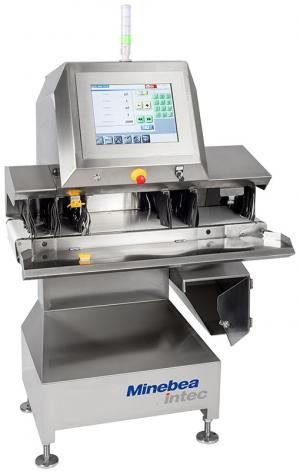
As the product moves along a conveyor belt at a constant speed, the X-ray system captures a continuous stream of images at regular intervals (e.g. every 0.8 mm). Once the entire product has passed through the X-ray beam, a complete greyscale image is generated. This image is then analysed and inspected for any foreign objects. Minebea Intec's X-ray machine can detect contaminants such as a 2 mm metal wire inside a yoghurt tub, something that would be undetectable for a conventional metal detector.
How to choose the most suitable system
Choosing the right X-ray inspection system depends on the type and shape of the product. Systems with X-ray generators positioned above the conveyor belt are the most commonly used in the food industry and are typically installed at the end of the production line. In these applications, packages are laid flat on the belt, allowing the X-ray beam to pass through the thinnest cross-section of the package. The Dylight and Dymond models are specially designed for this type of application. They feature a hygienic design, high detection sensitivity, and low energy consumption.
Side-view X-ray systems, where the beam is directed onto the conveyor from the side, are primarily used for upright products such as baby food jars. The Dymond S model is perfectly suited to this task, offering excellent detection sensitivity combined with low power consumption (also available in a chicane layout for small spaces). Dymond D, on the other hand, is a dual-beam X-ray inspection system that captures two images at a 90° angle.
Special X-ray inspection models
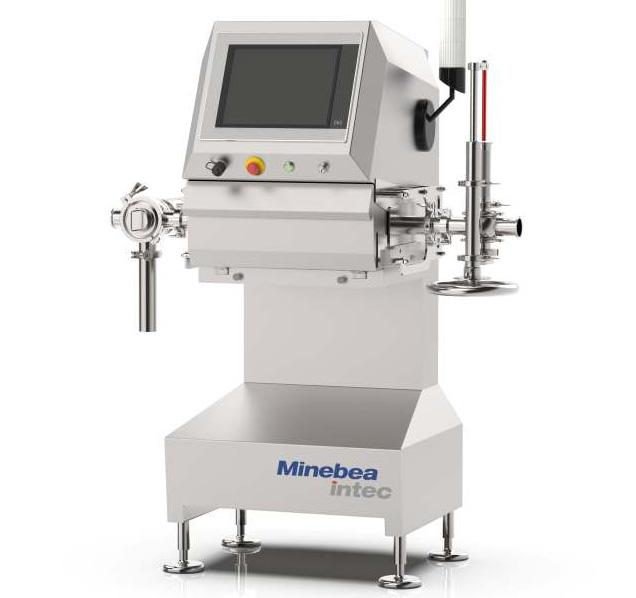
Minebea Intec has recently introduced Dypipe, a system specifically designed for liquid and viscous products. It features an innovative test insertion mechanism that enables checks during operation. To meet the stringent hygiene requirements of the meat processing industry, Dypipe is also equipped with an easy-to-open separator. For bulk goods in the food industry, the Dymond Bulk system offers outstanding X-ray inspection performance, making it ideal for raw materials such as vegetables, nuts, dried fruits and cereals. An optional multi-segment separator also ensures the precise and efficient removal of foreign bodies.
Everything from a single source
Advanced X-ray inspection systems are just one part of Minebea Intec's extensive product portfolio. From checkweighers and high-performance load cells for tank or silo weighing to industrial scales and user-friendly software solutions, the company offers customised support throughout every stage of project design.