

Mandatory BIS certification for machinery exports to India
A recent measure marks a significant change in the regulatory framework for importing numerous categories of industrial electrical machinery and equipment into India. Here are all the details of the regulation.
Stefano Lugli, Stefano Nicolussi (Technical Service Ucima)
In August 2024, India’s Ministry of Heavy Industries issued the Machinery and Electrical Equipment Safety (Omnibus Technical Regulation - OTR) Order, 2024, a regulation that marks a major shift in the rules governing the importation of numerous categories of electrical industrial machinery and equipment into India, including technologies for use in the packaging sector. As of 28 August 2025, Bureau of Indian Standards (BIS) certification and marking will be mandatory. It is worth noting that this certification requirement does not apply solely to companies exporting to India, but also to Indian manufacturers. The goal is to increase technological oversight of equipment used in India, while aiming to consolidate the country’s position as an alternative manufacturing hub to China.
In this context, the following aspects are worth noting:
- a clear intention to increase traceability and control over imported industrial products;
- an incentive for technology transfer to India through the enforcement of strict standards;
- a desire to reduce reliance on external international certifications;
- an awareness of the need to align with international machinery safety standards in order to curb indiscriminate imports.
At the same time, the OTR 2024 acts as a selective filter for incoming technologies by:
- promoting local joint ventures and production localisation;
- encouraging or supporting foreign players willing to establish a solid presence in the Indian market;
- raising barriers to entry for exporters with no local presence.
BIS certification is by no means a completely new requirement, as more than 700 products are already subject to this obligation, mainly consumer goods (under the ISI scheme). Certain electrical machine components have also long required BIS certification when sold independently as spare parts (cables, electric motors, gear motors, transformers, valves, etc.).
The new OTR 2024 introduces a new and particularly complex certification scheme for machinery, known as Scheme X. This scheme reflects the evolution of India’s regulatory framework for product safety and quality. While it draws inspiration from international models, it is strongly tailored to local priorities:
- It is based on Indian standards that closely follow ISO standards;
- It introduces a systemic approach to technical regulation, concentrating authority within Indian regulatory bodies;
- It makes prior technical compliance mandatory for a growing number of categories of capital goods.

Field of application
Annex 1 of the regulation explicitly lists the product categories (machinery, equipment, parts, components, control systems, electrical devices, etc.) subject to mandatory certification, each associated with specific customs codes. Whether or not a product falls under the certification requirement depends entirely on its customs classification. The list is extensive and covers a wide range of machinery types.
As for packaging production technologies, these are explicitly mentioned under customs code 842220, 842230, 842240, 842290. All companies are therefore encouraged to conduct a thorough audit of all technologies exported to India. In fact, all types of packaging machinery fall under the new BIS certification requirement. Furthermore, all spare parts listed under 842290 as specific packaging machinery parts are also covered.
If equipment or spare parts are supplied in the aftermarket and their customs code appears in Annex 1, then these items will also be subject to BIS marking, regardless of whether the original machine in use in India falls under a code that requires BIS certification. However, if such components are integrated into machines sold as complete units in India, they are not individually subject to BIS certification, since the regulation applies to the machine as a whole. Nonetheless, whether due to contractual reasons or internal company policies, manufacturers may choose to equip exported machines with BIS-marked components
Conformity
As the title of the Order 2024 introducing the new certification requirement (Machinery and Electrical Equipment Safety) suggests, ensuring compliance with key safety standards is now essential for placing machinery on the Indian market. Machines, machine parts and spare parts falling under the customs codes listed in Annex 1 must comply with the main internationally recognised ISO safety standards.
In particular:
- They must comply with Indian Standard IS 16819:2018, which is fully aligned with ISO 12100:2010, the foundational standard for the safe design of machinery;
- They must comply with all 53 ISO standards listed in Annex 2, where applicable. These include IEC 60204-1 on the safety of electrical equipment for machinery, the ISO 14122 series on requirements for access at height, ISO 14120 on guards, and others;
- They must comply with the type C ISO standards listed in Annex 3, although none of these apply to packaging technologies.
Conformity with these technical standards is therefore mandatory in order to export products subject to certification requirements to India.
The procedure
To begin with, it should be noted that there are two possible procedures:
- Certificate of Conformity (CoC) procedure, applicable to specific batches and shipments (which must therefore be repeated each time a batch is completed);
- License procedure, which covers all relevant types of machinery and is valid for a period of 3 to 6 years, depending on the case.
In both cases, the process starts with a mandatory pre-registration of the exporting company in India, along with a registration request for the specific types of machinery that will be exported to the country. Foreign exporters must use a dedicated platform for this purpose: the Foreign Manufacturers Certification Department (Scheme X), shown in Figure 1.
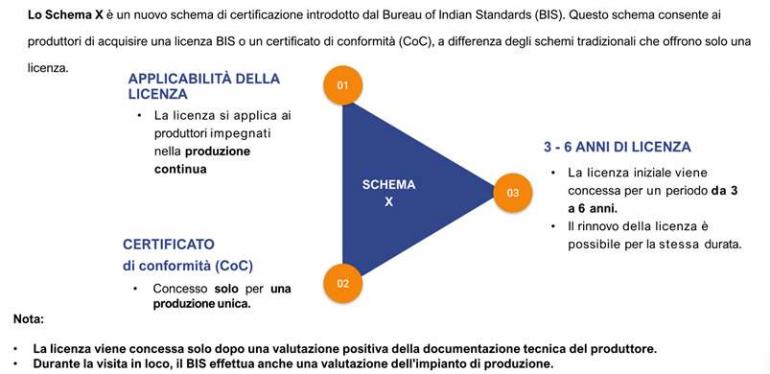
Scheme X is a new certification scheme introduced by the Bureau of Indian Standards (BIS) which allows manufacturers to obtain either a BIS License or a Certificate of Conformity (CoC), unlike traditional schemes which only offer a license.
LICENSE APPLICABILITY
- The license applies to manufacturers engaged in continuous production
CERTIFICATE OF CONFORMITY (CoC)
- Issued only for one-time production.
3-6 YEAR LICENSE
- The initial license is granted for a period of 3 to 6 years, with the possibility of renewal for the same duration.
Note:
- The license is granted only after a positive evaluation of the manufacturer’s technical documentation.
- During the on-site visit, BIS also conducts an assessment of the production facility.
Since BIS certification is effectively a hybrid between product certification and company certification, all production sites of the goods being exported to India must be indicated precisely at the time of registration. A fundamental prerequisite for both procedures is the appointment of an Authorised Indian Representative (AIR), whose name and details must be indicated in the registration. The AIR must be a resident of India and must formally declare responsibility, on behalf of the European manufacturer, for compliance with the relevant Indian laws, rules, regulations and terms and conditions of the BIS license, particularly regarding its issuance and ongoing validity. There do not appear to be any specific qualifications required for the AIR. Once registration is successfully completed, the process continues under the supervision of BIS personnel. After reviewing the Technical File of the machines and any other required documentation, BIS will carry out an on-site audit in Italy (at the exporter’s plant(s)) for both types of procedures. This audit will cover several areas, including the drafting of test reports in line with ISO 12100 and electrical safety testing in accordance with IEC 60204-1, which may be delegated to an internal company laboratory
Once the audit phase is complete, the final evaluation will be conducted in India based on the audit findings. If all checks are passed, either the CoC or the License will be issued, depending on the selected procedure. The procedure appears to be long, complex and costly. Companies will need to rely on consultants with specific expertise and must be prepared for inevitable delays. The BIS website itself cites a minimum timeframe of 6-8 months to complete the process.
The total cost of the procedure will also be significant. In addition to the certification process itself, companies must cover the full cost of the audit at the Italian production site along with related expenses (travel, accommodation, subsistence, etc.), as well as fees for the Authorised Indian Representative and necessary consultancy services.
Good news: deadline postponed to 1 september 2026
As the previous sections make clear, the original timeline made it virtually impossible to complete the required certification process by the proposed deadline of 28 August 2025. These practical challenges were raised by Ucima, both directly with the Indian authorities and through the relevant Italian ministries. For this purpose, a position paper was presented during the recent Italy-India government meeting held in Brescia on 5 June, where Ucima proposed a number of potential solutions to the Indian authorities:
- first and foremost, a one-year postponement of the entry into force of the regulation;
- once the system is fully operational, identifying international bodies located in key foreign countries who can be delegated to perform the audits on the manufacturer’s site, without having to wait for a BIS inspector to travel out from India.
The request for a postponement was accepted. In an order published on 13 June 2025 in the Gazette of India (S.O. 2579(E)), India’s Ministry of Heavy Industries officially amended the implementation timeline of the Machinery and Electrical Equipment Safety (Omnibus Technical Regulation) Order, 2024. The obligation will now come into force on 1 September 2026.
The postponement applies to the full range of products listed in Annex 1 of the regulation, including complex industrial machinery, automation equipment and electrical systems. It provides much-needed breathing room for foreign manufacturers, who will now have more time to update technical documentation, carry out testing procedures and submit certification requests to BIS-recognised bodies.
However, given the complexity of the accreditation system and the large number of product categories involved, it remains essential to begin work on compliance and preparation immediately.
Despite this extension, the issue remains highly topical and of primary interest for Indian authorities, who have recently activated sub-commissions to study the application, one specifically relating to the packaging sector.
Conclusion
The global surge in new regulations presents a fresh challenge for the Italian machinery industry, which now finds itself operating in an increasingly selective and independently regulated environment. More specifically, it is becoming increasingly important to take part in technical and regulatory discussions between the EU and India. BIS certification is now fully part of these discussions, particularly in light of the EU-India free trade agreement negotiations, which have recently gained momentum with the aim of being concluded by the end of 2025. As the world leader in machinery for the packaging industry and, more broadly, a key player in the capital goods sector, Italy must adapt its strategic approach to the Indian market. The OTR 2024 urges companies to rethink their internationalisation strategies: rather than acting merely as suppliers, Italian firms are encourages to become local development partners, with a stable technical and commercial presence and alliances with local players, factors that are becoming decisive. It is fair to say that regulatory compliance is now part of a company’s geopolitical strategy.
*The descriptions contained in the introduction and conclusion are partly based on material prepared by Federmacchine for the webinar entitled BIS Certification mandatory for exporting machinery to India and held on 15 May 2025.

Ucima services for bis certification
Ucima offers companies in the sector personalised guidance and support in meeting the various certification requirements:
-
- Assistance in correctly identifying company products (machinery, equipment, components and spare parts) subject to mandatory certification;
- Support with registration procedures;
- Support in identifying the Authorised Indian Representative (AIR);
- Preparation of the required Technical File to demonstrate compliance;
- Preparation of the reference document/checklist confirming application of ISO 12100 and other standards;
- Support with testing and trials, including setting up internal testing laboratories;
- On-site support during BIS audits;
- Assistance with the procedure and direct contact with the BIS office in India