
Global luxury holds strong and regains momentum
According to the 24th Altagamma Monitor, the luxury market remained stable at a value of €1.44 trillion in 2025, despite a challenging period marked by geopolitical tensions, more selective spending and tepid demand from Chinese consumers. The outlook for 2026 remains positive.
Milena Bernardi
Against a global backdrop of economic uncertainty and shifting consumer behaviour, the high-end segment has demonstrated remarkable resilience, closing 2025 on a stable note. This is the picture that emerges from the Altagamma Monitor 2025, which estimates the total value of the global luxury market at €1.44 trillion, in line with 2024 figures. A similar trend was observed in the personal luxury goods market, which ended the year at €358 billion, a 2% decline at current exchange rates but broadly stable at constant rates.
The sector’s current status and outlook for 2026 are detailed in two key reports: the Altagamma Consensus 2026 and the Altagamma–Bain Worldwide Luxury Market Monitor 2025.

A resilient and constantly evolving market
The year 2025 was marked by significant structural shifts, primarily driven by changing consumer preferences – with experience taking precedence over the product itself – and an increasingly critical relationship between price and value. Geographical performance was mixed: the Middle East continued to expand (+4% to +6%) and the Americas showed signs of recovery (0% to +2%) thanks to greater domestic spending and higher average purchasing values. Europe experienced a slowdown (-3% to -1%) and China remained weak (-8% to -6%), while Japan saw a contraction (-8% to -6%) following its exceptional performance in 2024. Performance varied by category, reflecting a sharp polarisation between the highest-end segments and more accessible price points. In the personal luxury segment, jewellery (+4% to +6%) and eyewear (+2% to +4%) both performed well, while leather goods and footwear saw a decline (-7% to -5%). The automotive sector contracted across all price brackets, although high-end sports cars performed better than the average. The nautical sector continued to grow robustly, while furniture design stabilised. High-end wines and spirits struggled, with the notable exception of premium sparkling wines and Italian reds.
In this scenario, the Italian high-end industry, which accounts for more than 7% of national GDP, continues to demonstrate resilience thanks to the creativity and manufacturing excellence of the entire supply chain - said Matteo Lunelli, Chairman of Altagamma - Now more than ever, this sector needs to be protected in terms of legality, transparency and regulatory certainty to safeguard the reputation of Made in Italy worldwide. We are working with the government and other associations to forge a new supply chain agreement, backed by the serious and responsible commitment of our companies.

Outlook for 2026
The outlook for the current year is encouraging. The Altagamma Consensus 2026 predicts growth of around 5% for the sector, in line with the longer-term forecast of between 4% and 6%. This growth will be underpinned by cost optimisation measures and the strong performance of specific markets.
The United States remains the key market
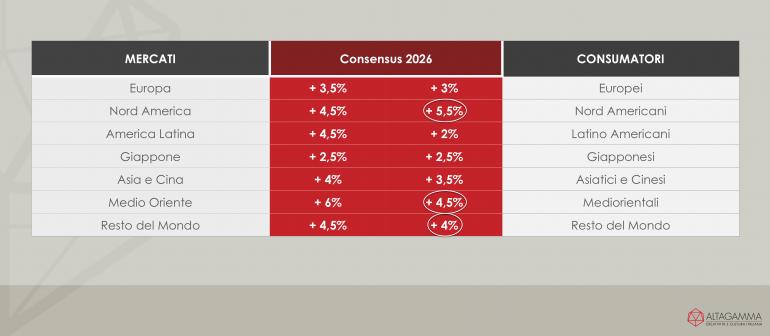
Having weathered the impact of tariffs, the United States will remain the largest market in 2026 with estimated growth of 4.5%, driven in part by a 5.5% expansion of the consumer base. The Middle East remains highly dynamic with 6% growth, fuelled by tourism and real estate investment. In contrast, Europe is expected to see a more modest trend (+3.5%) amid political and economic instability, particularly in France and Germany. Asia is recording growth (+4%), led by Korea and followed by Thailand, Indonesia and Singapore, while China is expected to regain momentum (+4% in consumption). India is also expanding (+7%), although it remains a relatively small market. Following the 2025 slowdown, Japan may return to growth in 2026 thanks to a weaker yen. Latin America is expected to see growth of 4.5%, driven by a new elite of high-end consumers and the expansion of local retail, particularly in Brazil and Mexico. The rest of the world is projected to grow by 4.5%.
Physical retail remains crucial
Brick-and-mortar stores remain the dominant channel for personal luxury goods, with 5% growth expected in 2026, driven in part by expansion into new markets. The channel continues to evolve through increasingly experience-based and personalised formats aimed at high-spending consumers. Key growth areas include second-tier US cities, the Middle East and Latin America, where brands are strengthening their presence through boutiques, dedicated showrooms and hybrid spaces that integrate retail with entertainment and experiential offerings, such as cafés and restaurants. In parallel, digital retail is set to grow by 4.5%, driven by closer integration with brick-and-mortar stores as part of an omnichannel strategy.
Growth will be more subdued in the physical and digital wholesale segments (+2% and +1%, respectively), as offline and online department stores continue to face structural difficulties, albeit with divergent trends. Physical multi-brand boutiques remain highly attractive to consumers and potentially significant for brands – particularly emerging ones – and remain a strategic focus in the US. The off-price segment (both physical and digital) for luxury goods continues to perform well and is set to maintain its upward trajectory.
Products: strong polarisation between brands
The conditions for moderate growth in sales volumes that were established in 2025 are set to consolidate in 2026. The market is showing divergent trends across sectors. Jewellery remains one of the most dynamic segments (+5%), reinforcing its status as a safe-haven asset and investment (with branded jewellery also on the rise). The high-end jewellery sector now commands a global market worth over €31 billion. Footwear is expected to grow by 3%, while leather goods are showing more positive signs (+4%). Cosmetics are projected to see a 4% recovery in 2026 (a smaller increase than in the past), driven by trends in longevity and wellness. This sector also continues to perform well online, with growing engagement among younger consumers. Niche perfumes are maintaining their strong performance, while Korea remains the primary hub for skincare, a category that is becoming increasingly integrated with technology. The clothing sector is expected to see 4% growth, although performance will be highly polarised between brands. Aspirational consumers are seeking moderately priced offerings, prompting some fast-fashion brands to implement elevation strategies. For the current year, high-end fashion is expected to see volume growth as brands introduce more lower-price items.
This is a moment of truth - say Claudia D’Arpizio and Federica Levato, Senior Partners at Bain & Company and authors of the report - Luxury stands at a crossroads between exclusivity and inclusivity, between profit and purpose. Only those who successfully combine creativity with social conscience will be able to transform this transition into longevity. The fundamentals remain strong, with personal luxury goods expected to see annual growth of 4-6% fuelled by rising demand. This could propel the market to between €525 billion and €625 billion by 2035, with total luxury spending ranging from €2.2 trillion to €2.7 trillion.