

Pharma and packaging: a winning combination (tariffs permitting)
Two key sectors of Italian industry working in synergy. Yet the shadow of Donald Trump's trade war still looms over their otherwise excellent performance
Generoso Verrusio

Within the landscape of Italian industry, the pharmaceutical sector stands out as a flagship, not only for its production capacity and economic value, but above all for the innovation it generates across key manufacturing segments. Packaging is unquestionably one of these “core” segments.
To better understand the mutually reinforcing relationship between pharma and packaging, the two “twin engines” of Italian industrial innovation, we can look to two comprehensive studies, prepared and presented respectively by Farmindustria and UCIMA during their general assemblies last July.
The Farmindustria analysis
According to Farmindustria, Italian pharmaceutical production reached a turnover of €56 billion in 2024 (+7,6% compared to 2023), with exports of €54 billion (over the last five years, Italy has exceeded the European average, with a growth of 65% compared to the EU's 57%). Investments totalled €4 billion, of which €1.7 billion was allocated to high-tech facilities and €2.3 billion to research and development. The innovative drive is confirmed by a 33% increase in patent applications over the past five years, compared to an 18% increase seen in other major European economies.
In terms of employment, the pharmaceutical sector employs 71,000 direct employees, 90% of whom hold a university degree or diploma, with a strong female presence: 45%, compared to a national average of 29%, often in senior roles. Employment has grown by 8% over the past five years, double the national average, and increases to over 300,000 workers when including related industries and the broader supply chain.
These record-breaking figures position the sector at the top of Italian industry in terms of positive trade balance, which stood at €21 billion in 2024. Behind this success lies the contribution of high-precision packaging machinery, essential for ensuring both regulatory compliance and product safety.
UCIMA data
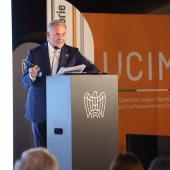
According to the 13th statistical survey by UCIMA-Confindustria, the pharmaceutical sector ranks as the second-largest customer for Italian packaging machinery, accounting for 17.3% of total industry turnover (equivalent to approximately €1.7 billion).
Of these machines, a significant 79.2% are exported, with Europe (€615 million), Asia (€293 million) and North America (€155 million) as the leading markets. Growth is particularly dynamic in India, Turkey and Brazil, emerging markets where Italian technology continues to gain ground.
The production chain is marked by a high level of specialisation. The most in-demand machine categories include: filling and dosing machines (€421 million in turnover); forming, filling, FFS closing and thermoforming machines (€376.4 million); and cartoning and case packing machines (€193.9 million).
The pharmaceutical industry is also distinguished by the technical complexity of its packaging needs. Machines must ensure traceability and serialisation, support visual inspection and process automation and be compatible with eco-friendly materials.
The uncertainty of tariffs
Looming in the background is a significant variable: Donald Trump. While recent bilateral agreements between the United States and the European Union include provisions for 15% tariffs, it remains unclear whether the promised exemptions for European pharmaceutical products will actually be implemented.
Further destabilising the context is the ongoing U.S. investigation into the pharmaceutical industry under Section 232 of the Trade Expansion Act. This measure – previously applied to industries such as steel and aluminium – could pave the way for unilateral protectionist actions, bypassing existing international trade agreements.
With over €10 billion in pharmaceutical exports to the U.S., the risk of a significant downturn across the entire drug supply chain, including packaging machinery, remains a possibility that cannot be ignored.