

Driving growth in Italy: JAKA Robotics invests in training and local partnerships
The company is leveraging training programs and customer success stories to fuel its growth strategy.
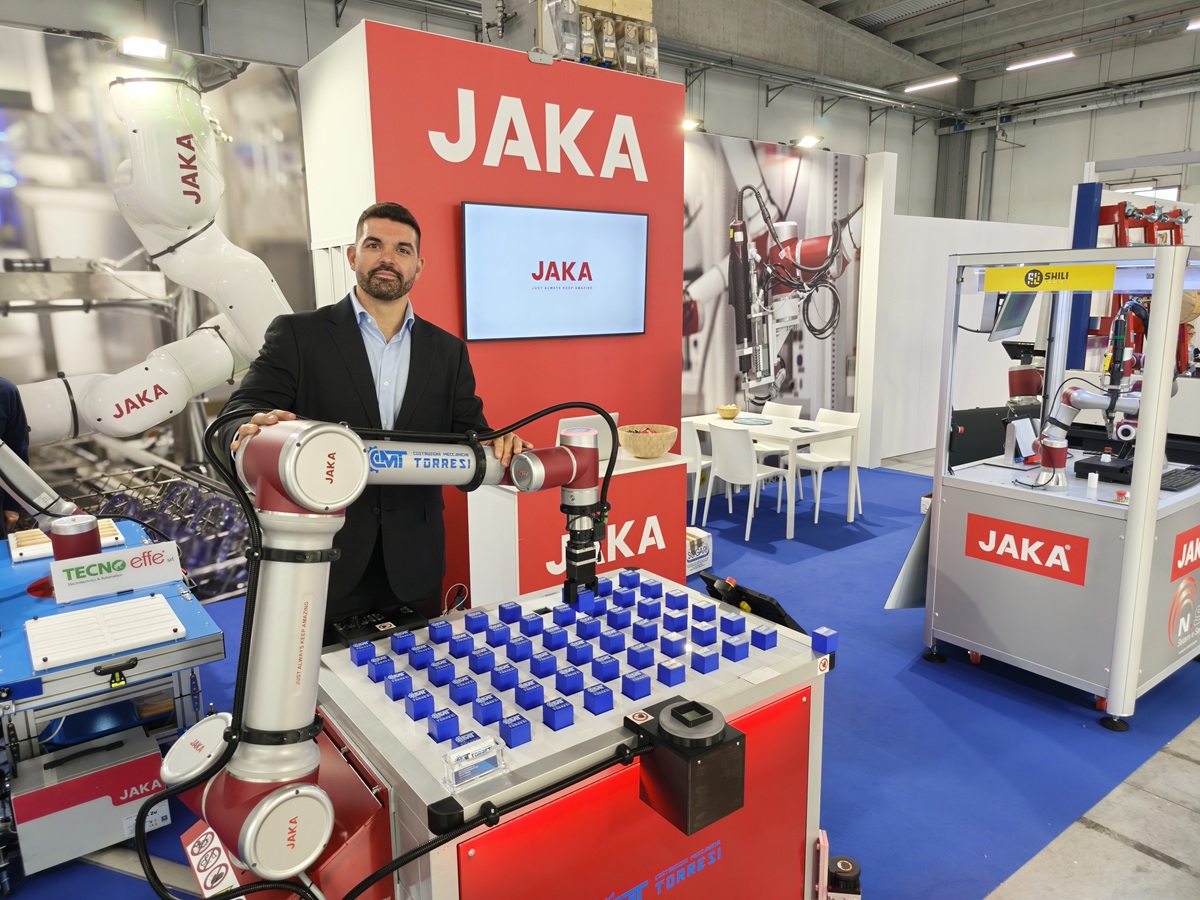
JAKA Robotics continues its growth and consolidation in the market, strengthening its expansion strategy in Italy with key initiatives such as training programs and collaborations with system integrators and partners — all contributing to an increasingly sophisticated portfolio of advanced solutions.
Giacomo Mariotti, JAKA's Country Manager for Italy, tells us: “With the launch of its new portable Education Kit at MECSPE, JAKA is further expanding its footprint in the automation landscape. In addition to working with system integrators — already key players in the market — the company has set its focus on training the next generation of technicians and robotics experts. The kit, designed as a plug-and-play solution for educational use, includes a JAKA MiniCobo, vision system, and gripper, all mounted on a mobile trolley. It marks a step towards building a network of training centres for both existing and prospective customers, as well as high school and university students.
In the initial phase, the network will include distributors, service partners, and after-sales providers based between Lombardy and Emilia-Romagna. These partners will feature showrooms and dedicated training areas showcasing the Education Kit, among other solutions.
With the upcoming presentation of the project at A&T Vicenza in October 2025, we aim to expand our reach across northern Italy—an increasingly dynamic and promising region for automation.”
Successful cases from North to South
A series of case studies presented at key industry trade fairs in the first half of 2025—including MECSPE, SPS Italia, and IPACK-IMA—highlight a growth path driven by innovation. On this topic, Mariotti explains: “Trade fairs are a key opportunity for JAKA to showcase real-world applications where our technology has made a tangible difference: automating tedious or heavy manual processes, solving space constraints with compact solutions, and bringing flexibility and efficiency to packaging, end-of-line, and welding processes across sectors from food to nutraceuticals. One such example comes from ESCA “ Mariotti continues “a family-run confectionery business in Sardinia, which automated its packaging line for gluten-free ladyfingers using a JAKA solution implemented by Emilia-based integrator Tecnoeffe. The first cobot, equipped with a Bernoulli-effect end effector, gently lifts the biscuits without contact and places them in boxes. A second cobot then inserts a layer of tissue between each ladyfinger, arranges them in a tray, and places the tray into a pack, which is subsequently sealed under modified atmosphere conditions.”
Switching from food to nutraceuticals, another success story involves AFT, which built a boxing automation line using two synchronized 1 kg JAKA MiniCobos.
“The first cobot picks up the tube from the conveyor belt and places it into a carton,” Mariotti explains. “The second cobot then positions the carton in a box. The system is optimized for tight spaces, high speed, and energy efficiency. Together, the two cobots consume an average of just 150 watts—about half the power of a typical hairdryer. Shared motors between joints, high-performance components, and Industry 4.0/5.0 readiness for real-time monitoring cut energy consumption by 50%.”
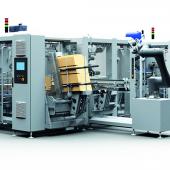
Looking at the end-of-line automation—a growing market for JAKA—the standout case involves UNITED SYMBOL with a carton packaging line for the residential sector.
“American-style cardboard boxes are conveyed to a palletizing cell featuring JAKA’s palletizing add-on and a 20 kg cobot operating in wireless mode,” says Mariotti. “The cell handles two pallet bays, where the cobot performs multi-grip handling of various box formats before placing them into cartons pre-formed by an operator.”
Finally, in southern Italy, CMA — an integrator and service partner based near Naples—has built a flexible box-forming line in an environment requiring frequent format changes.
“Where average machine downtime previously reached 45 minutes, JAKA’s Zu12 cobot now enables high-speed operation in compact spaces with fast format switching,” Mariotti notes. “The same gripper can automatically adapt to different formats based on digital instructions, creating different stacks for various packaging types. With low cycle times, the cell can safely remain open; at higher speeds—up to 8 boxes per minute—laser scanners and safety systems can be added. Flexibility is further enhanced by the mobile design: the entire solution can be moved with a pallet jack and redeployed quickly thanks to a 200-volt mains connection and adaptable equipment.”