

Africa: the new frontier for italian packaging
Six countries to watch closely. Africon GmbH and Mecs have developed a map of the most promising markets for Italian packaging technologies. Food, beverage and pharma are the key sectors driving machinery demand across the continent
Luca Baraldi e Generoso Verrusio
Africa is emerging as one of the most promising regions for the development of Italian packaging technologies. This is no exaggeration nor speculation: the conclusion comes from a detailed analysis conducted by Africon GmbH and Mecs for Ucima, presented in Modena at the end of October during the conference “The African Market - How to benefit from the African potential”.
A macro-level analysis
Starting from an assessment of 54 African countries, the study progressively focused on the 20 main economies, and ultimately identified six priority markets, based on indicators measuring the actual market potential for packaging technologies, the business environment, and the operational risks for companies.
The final ranking places South Africa, Egypt and Nigeria as top-priority markets, followed by Algeria, Morocco and Côte d’Ivoire. These countries have shown strong demand for packaging machinery in 2024, a rapidly expanding industrial base, and significant weight within regional value chains. Indeed, the report highlights that Africa’s main economies are also those with the highest manufacturing capacity.
In 2024, South Africa recorded a GDP of USD 403 billion, followed by Egypt (USD 380 billion) and Algeria (USD 260 billion). These nations also lead in industrial output, boasting advanced manufacturing sectors and better-developed logistics infrastructures. Nigeria, with over 230 million inhabitants, is the continent’s most populous country and the fastest-growing urban economy, while Tanzania and Uganda top the charts for urbanization rates.
Focus on food, beverage and pharma
According to Africon, the main drivers of packaging demand in Africa are the food, beverage and pharmaceutical industries.
As of 2025, there are more than 400 active pharmaceutical manufacturers across the continent, with a strong concentration in Egypt, South Africa, Algeria and Nigeria – together accounting for over three-quarters of Africa’s production capacity. Most local producers focus on generic drugs, but rising domestic demand is encouraging new investments.
The food & beverage sector is even broader. Africa counts over 30,000 companies, mostly SMEs. The ranking by number of producers is led by Nigeria (8,090), followed by Egypt (over 7,000), Algeria (7,059) and South Africa (5,501), with Ghana, Tanzania, Morocco and Côte d’Ivoire following closely behind.
A common trend across all countries examined is the increasing mechanization of production lines and a growing demand for eco-friendly and sustainable packaging solutions.
Italy, the leading supplier
Between 2020 and 2024, Italy captured 28% of Africa’s packaging machinery imports, positioning itself as the continent’s leading supplier, ahead of Germany (23%) and China (15%). Italian machinery is highly valued for filling, packaging and sealing applications, representing a preferred choice among local manufacturers seeking to improve efficiency and product quality.
Alongside European players, the report notes the growing presence of Asian brands such as Newamstar, TechLong, Sunswell and Zhangjiagang, offering lower-cost alternatives – though still below European standards in terms of quality and reliability.
The issue of single-use plastics remains a strategic topic. Several African countries have introduced bans and regulations, though enforcement varies: Rwanda and Kenya are the most advanced and strict in implementation, while Egypt and Angola are still in early or voluntary stages. This scenario is fueling interest in alternative materials and recycling technologies, creating substantial opportunities for sustainable packaging solutions.
Risks and outlook
Africon’s report devotes significant attention to risk factors. The main challenges include corruption, inflation, and limited foreign currency availability. Among key markets, Morocco, South Africa and Côte d’Ivoire show the lowest operational risk, while Egypt and Nigeria call for more cautious entry strategies due to currency volatility and political instability.
On the macroeconomic front, Africa is showing signs of improvement, driven by growing regional integration. The African Continental Free Trade Area (AfCFTA) – signed by 54 countries and already operational in 24 – aims to create a single market of 1.3 billion people with a combined GDP of USD 3.4 trillion. According to Africon, AfCFTA could increase Africa’s income by USD 450 billion by 2035, fostering a more favorable context for intra-African trade and partnerships with Europe.
Ucima: “Building lasting partnerships”
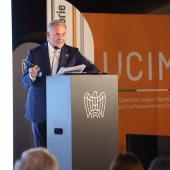
During the conference, moderated by ItaliaImballaggio’s editor Davide Miserendino, Riccardo Cavanna (Ucima President) and Giammarco Scala (Vice President, Confindustria Assafrica & Mediterraneo) repeatedly emphasized the importance of building strong and lasting partnerships between Italian companies and African partners – leveraging the sector’s technological know-how and innovation capacity.
The event also featured contributions from Italian companies already active in Africa, including SACMI, IMA Group, Friostar Srl and Ricciarelli Spa. The lively roundtable highlighted the need for consistent and structured market presence, with long-term strategies and reliable local partnerships.